






On transpire toute l'année. Mais c'est en été que les inquiétudes remontent : « Est-ce que mon déodorant va vraiment tenir? », « Et si ça me fait un rash? », « Est-ce que ça va tacher mes vêtements? »
Ces questions sont légitimes. Tu transpires davantage quand il fait chaud, donc tu mets ton produit à plus rude épreuve. Et entre les promesses marketing, les ingrédients incompréhensibles, et les avis contradictoires sur Internet, c'est difficile de savoir ce qui fonctionne vraiment.
Voici les 5 questions que je reçois le plus souvent — pas du marketing, juste de la chimie cosmétique appliquée et des réponses honnêtes, basées sur l'expérience et la science.
C'est parti.
1. Pourquoi un déodorant naturel échoue parfois en été?
Réponse courte : Parce que la formulation n'a pas été pensée pour vraiment neutraliser les odeurs sous une transpiration importante.
Comprends d'abord d'où vient l'odeur. Ta sueur fraîche est inodore. L'odeur apparaît seulement quand les bactéries présentes sur ta peau « mangent » les molécules de la sueur et libèrent des composés odorants.
Pour empêcher l'odeur, il faut donc agir sur les bactéries, pas sur la sueur.
Le piège des formules trop simples : beaucoup de déodorants naturels s'appuient sur un seul actif neutralisant, à une concentration parfois trop faible. Quand tu transpires davantage en été, cet actif unique est rapidement dépassé.
Ce qui fait vraiment la différence : une combinaison synergique de plusieurs actifs, qui agissent à différents niveaux — modifier doucement le pH de la peau, neutraliser les molécules odorantes, et inhiber les bactéries directement.
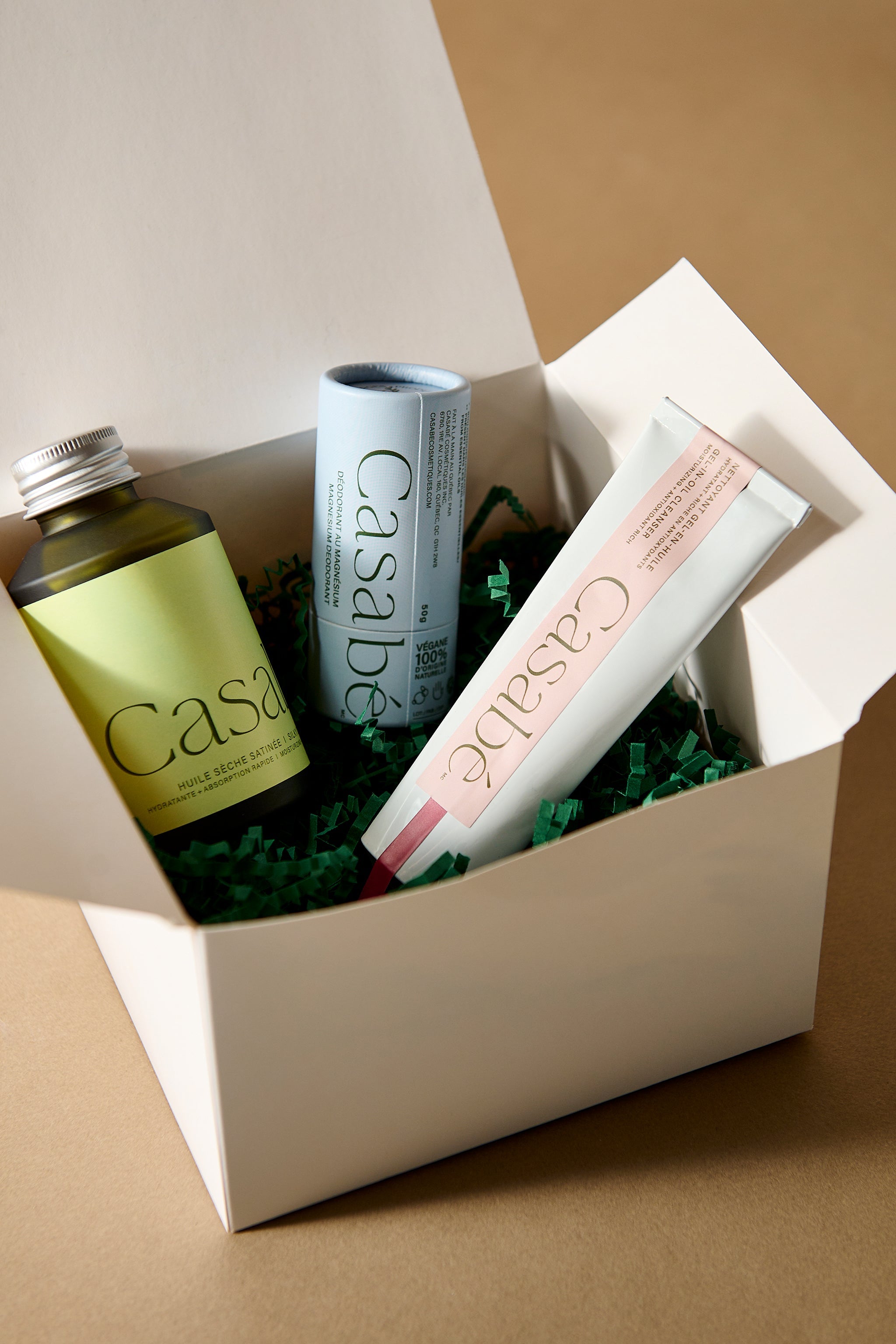
C'est exactement la philosophie derrière le déodorant Casabé : trois actifs complémentaires (hydroxyde de magnésium, extrait de sureau, ricinoléate de zinc) plutôt qu'un seul, plus 12 autres ingrédients soigneusement sélectionnés pour la performance et le confort. Fabriqué au Québec, dans un format rechargeable écoresponsable.
Formuler un déodorant naturel vraiment efficace, c'est un vrai défi technique. Mais c'est faisable — et ça se sent à l'usage.
2. Pourquoi mon déodorant naturel m'a déjà fait un rash?
Réponse courte : Très souvent, le coupable est le bicarbonate de soude.
Le bicarbonate de soude (pH ~8-9) est très alcalin alors que ta peau a un pH naturel autour de 5,5. Cette différence peut perturber ta barrière cutanée et causer une irritation chimique.
Mais il y a un deuxième problème dont on parle peu : la granulométrie. Le bicarbonate utilisé dans beaucoup de déodorants n'est pas finement broyé, et ses cristaux créent une abrasion mécanique sur la peau fragile des aisselles. C'est cette friction, souvent invisible mais répétée, qui aggrave les rougeurs.
Et l'hydroxyde de magnésium alors? N'est-il pas aussi alcalin?
Bonne question. Oui, il est techniquement alcalin (pH 9-10,5 dans une solution concentrée). Mais voici ce qui change tout : sa solubilité dans l'eau est extrêmement faible (0,00064 g/100 ml à 25°C, soit environ 2500 fois moins soluble que le bicarbonate).
Concrètement, ça signifie deux choses :
- Il se dissout très lentement et progressivement dans la sueur, libérant son alcalinité de façon graduelle. Ta peau a le temps de s'adapter.
- Sa faible solubilité l'empêche d'amener le pH de la sueur au-dessus du neutre (~7) — alors que le bicarbonate, lui, dissout instantanément et fait monter le pH brutalement.
Et bonus important : la texture de l'hydroxyde de magnésium en poudre fine est soyeuse, pas abrasive — contrairement aux cristaux du bicarbonate.
Et la période d'adaptation, c'est important?
Oui, très important, et personne n'en parle assez.
Si tu utilises depuis longtemps un antiperspirant à l'aluminium, tes pores se sont « habitués » à être bloqués. Quand tu passes à un déodorant naturel, tes pores se désobstruent progressivement. Pendant cette phase de 2 à 3 semaines (qu'on appelle parfois « période détox »), tu peux ressentir :
- Une transpiration qui semble plus abondante qu'avant
- Le besoin de réappliquer ton déodorant dans la journée
Ce n'est pas que le déodorant naturel ne fonctionne pas. C'est ton corps qui retrouve son fonctionnement normal. Persévère 2-3 semaines, et la situation s'équilibre.
💡 Conseil pratique : démarre la transition vers un déodorant naturel à un moment où tu peux réappliquer librement si besoin — pas la veille d'une grande présentation au travail.
3. Est-ce qu'un déodorant naturel tache les vêtements?
Réponse courte : Pas s'il est bien formulé. Mais attention, les déodorants peuvent tacher de deux façons différentes.
Les fameuses taches jaunes sur les t-shirts blancs ne viennent pas de la sueur. Elles viennent de la réaction chimique entre l'aluminium des antiperspirants et les protéines de la sueur. Pas d'aluminium = pas de tache jaune.
Mais il y a aussi les taches blanches à l'application, causées par des formules trop grasses, ou trop concentrées en fécules absorbantes (comme l'arrow-root ou la fécule de maïs) ou en pigments minéraux. Pire encore : certains déodorants naturels forment des grumeaux après l'application — quand les poudres absorbantes rencontrent la chaleur et le frottement de la peau, elles s'agglomèrent en petits dépôts secs. Ce phénomène est aggravé quand la texture de base de la formule n'est pas suffisamment lisse. Ces dépôts se détachent ensuite sur les vêtements, qu'ils soient clairs ou sombres.
Ce qui fait la différence d'un déodorant bien formulé : une texture soyeuse, qui glisse, ne grumelle pas, et ne laisse pas de résidu visible. C'est exactement ce qu'on a travaillé pour le déodorant Casabé — une texture légère qui pénètre rapidement, sans grumeaux, sans tache, ni blanche ni jaune.
4. Sans aluminium, est-ce vraiment efficace?
Réponse courte : Oui, parce que l'efficacité ne dépend pas de l'aluminium.
Fais la différence entre deux types de produits :
- Un antitranspirant (à l'aluminium) bouche mécaniquement les pores pour empêcher la sueur de sortir. Il interfère avec le processus naturel de régulation de ta température corporelle.
- Un déodorant naturel te laisse transpirer normalement (ce qui est sain), mais empêche les bactéries de transformer ta sueur en odeur.
Le résultat final est le même (pas sentir mauvais), mais l'approche est complètement différente — et celle du déodorant naturel respecte ta physiologie.
Sur la santé : plusieurs études ont soulevé des questions sur l'absorption cutanée de l'aluminium à long terme. Bien que le débat scientifique ne soit pas définitivement tranché, beaucoup choisissent de réduire leur exposition par précaution — surtout dans une zone aussi proche du sein.
5. Comment reconnaître un bon déodorant naturel?
4 critères à regarder sur l'étiquette :
✓ Sans aluminium ET sans bicarbonate de soude
La base. Ces deux ingrédients sont les principaux responsables des inquiétudes et des irritations.
✓ Une combinaison de plusieurs actifs neutralisants
Un seul ingrédient ne suffit presque jamais. Cherche une formule qui combine plusieurs approches : alcalinisation douce, inhibition bactérienne, neutralisation des composés odorants.
✓ Une texture qui te convient
Un bon déodorant doit glisser, pénétrer rapidement, et te laisser le sentir invisible sur la peau. Pas grumeux, pas collant, pas gras.
✓ Une formule transparente, avec une origine claire
Vérifie que tu peux comprendre tous les ingrédients. Privilégie les marques qui fabriquent en petits lots, dans des conditions éthiques, et qui sont transparentes sur l'origine de leurs ingrédients.
Et le parfum dans tout ça?
C'est un point qu'on oublie souvent et pourtant il fait une vraie différence au quotidien.
Beaucoup de déodorants — naturels comme conventionnels — sont fortement parfumés, parfois avec des parfums synthétiques ou des combinaisons d'huiles essentielles intenses. Le problème : ce parfum entre en conflit avec ton propre parfum, celui que tu mets sur ton poignet ou ton cou, celui qui te ressemble.
Chez Casabé, on a fait le choix d'offrir deux versions :
- Une fragrance 100% d'origine naturelle (canneberge, pomme, bergamote) très douce, conçue pour ne pas entrer en conflit avec tes parfums préférés.
- Une version sans parfum, pour celles qui préfèrent zéro odeur ajoutée — pratique aussi si tu as la peau réactive ou si tu adores changer souvent de parfum.
En résumé
Un bon déodorant naturel, c'est un produit complexe à formuler. Ce n'est pas un seul ingrédient miracle — c'est l'équilibre entre plusieurs actifs, une texture pensée, et le respect de la physiologie de ta peau.
C'est exactement la philosophie derrière le déodorant au magnésium Casabé : 15 ingrédients d'origine végétale et minérale, fabriqué à la main au Québec avec de l'huile de canneberge bio. Rechargeable dans un tube réutilisable, avec des recharges en carton compostable. Sans aluminium, sans bicarbonate, sans alcool. 🌿
Découvre le déodorant Casabé →
Tu as une question? Écris-moi en message privé — je réponds toujours personnellement.


